NYC Office of Nightlife
NYC Office of Nightlife
Audience
Audience
/
Location
Location
NYC
NYC
How might we map, measure, and decarbonize the NYC Nightlife sector while catalyizing a greater movement towards reaching NYC climate goals?
How might we map, measure, and decarbonize the NYC Nightlife sector while catalyizing a greater movement towards reaching NYC climate goals?

The premise
Climate work has a reach problem. The people most able to move culture - DJs, bartenders, club owners, the rooms where a neighborhood actually gathers at midnight - are almost never in the room when climate strategy gets made. Meanwhile the venues themselves sit on real climate leverage: energy loads, waste streams, and, in New York, looming legal mandates (Local Law 97, the CLCPA) that turn carbon into a financial forcing function.
The Nightlife Climate Constellation (NCC) treats that overlap as an opportunity. The core bet: nightlife venues are trojan horses for climate solutions. Pleasure and culture aren't decoration on top of systemic change - they're the infrastructure that makes it spread. Nightlife produces the exact emotional states real change requires: possibility, transformation, collective energy.
The goal isn't conversion. It's contagion.
The theory of change
I built NCC around a single reframe: a venue is not a building to be audited - it's a bright spot, a piece of persistent cultural infrastructure that, once it comes online, makes the next one want to follow.
Where most climate programs target one-off events or chase compliance top-down, NCC organizes venues into a peer-to-peer coalition. One rooftop going solar becomes a story the venue down the block can see itself in. Density becomes intensity. The network is the argument.
The whole model backcasts from a preferable future - the Field of Possibility - and works backward to what a single neighborhood could do right now. We started with one: the Bushwick/Ridgewood corridor, a roster of 318 venues.


The work so far
Theory and strategy. Developed the theory of change, the coalition strategy, and the visual and editorial language that lets the whole thing read as culture rather than compliance.
Stakeholder research. Interviewed across the full chain - climate-solution practitioners (solar, building decarbonization, composting, plastics elimination), venue owners and operators, and event organizers - to learn what each side actually needs in order to say yes.
Partnerships. Brought a roster of vetted climate providers into the pilot - Brooklyn Solar Works, SolarOne, Eficity, Bye Bye Plastic, and Groundcycle - and secured fiscal sponsorship and grant funding (DSBS Neighborhood 360, through the Sound Future Foundation) to anchor the work.
Public education and the stage. Presented the vision four years running from the stage at House of Yes, and grew Marketplace of the Future (MOTF) into Climate Week NYC's longest-running event - a TEDx-style platform now expanding to other cities.
Community. Built the coalition on the ground through monthly events - the slow, real work of turning a thesis into a scene that actually shows up.
Where it stands
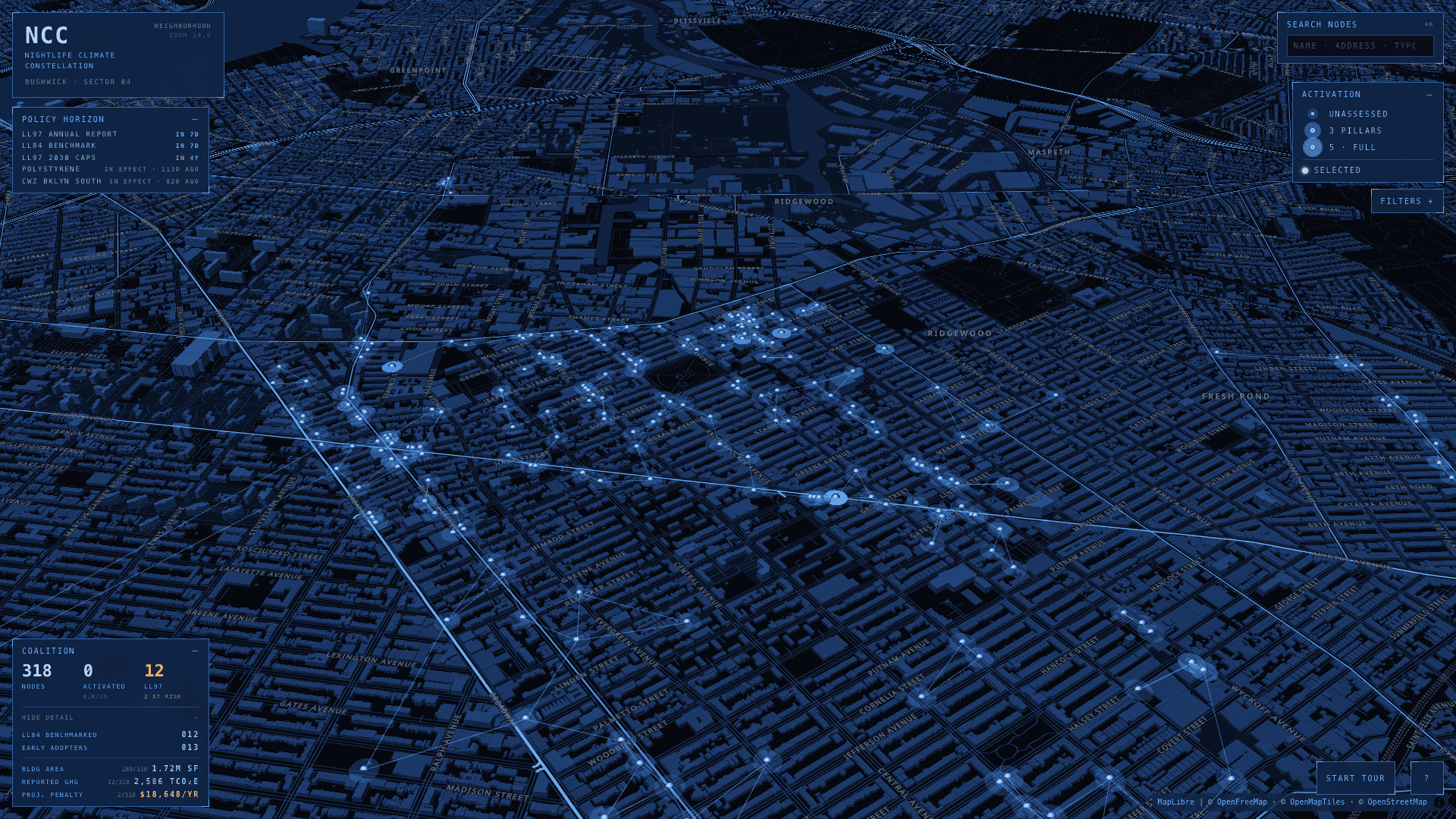
NCC is now being built into a platform: an onboarding system that lets venues join the coalition and watch their node light up on a living map of the neighborhood. Each venue that comes online glows. The picture fills in.
Not a finished utopia. A work in progress that's already beautiful.



NYC Office of Nightlife
NYC Office of Nightlife
Audience
Audience
/
Location
Location
NYC
NYC
How might we map, measure, and decarbonize the NYC Nightlife sector while catalyizing a greater movement towards reaching NYC climate goals?
How might we map, measure, and decarbonize the NYC Nightlife sector while catalyizing a greater movement towards reaching NYC climate goals?
The premise
Climate work has a reach problem. The people most able to move culture - DJs, bartenders, club owners, the rooms where a neighborhood actually gathers at midnight - are almost never in the room when climate strategy gets made. Meanwhile the venues themselves sit on real climate leverage: energy loads, waste streams, and, in New York, looming legal mandates (Local Law 97, the CLCPA) that turn carbon into a financial forcing function.
The Nightlife Climate Constellation (NCC) treats that overlap as an opportunity. The core bet: nightlife venues are trojan horses for climate solutions. Pleasure and culture aren't decoration on top of systemic change - they're the infrastructure that makes it spread. Nightlife produces the exact emotional states real change requires: possibility, transformation, collective energy.
The goal isn't conversion. It's contagion.
The theory of change
I built NCC around a single reframe: a venue is not a building to be audited - it's a bright spot, a piece of persistent cultural infrastructure that, once it comes online, makes the next one want to follow.
Where most climate programs target one-off events or chase compliance top-down, NCC organizes venues into a peer-to-peer coalition. One rooftop going solar becomes a story the venue down the block can see itself in. Density becomes intensity. The network is the argument.
The whole model backcasts from a preferable future - the Field of Possibility - and works backward to what a single neighborhood could do right now. We started with one: the Bushwick/Ridgewood corridor, a roster of 318 venues.
The work so far
Theory and strategy. Developed the theory of change, the coalition strategy, and the visual and editorial language that lets the whole thing read as culture rather than compliance.
Stakeholder research. Interviewed across the full chain - climate-solution practitioners (solar, building decarbonization, composting, plastics elimination), venue owners and operators, and event organizers - to learn what each side actually needs in order to say yes.
Partnerships. Brought a roster of vetted climate providers into the pilot - Brooklyn Solar Works, SolarOne, Eficity, Bye Bye Plastic, and Groundcycle - and secured fiscal sponsorship and grant funding (DSBS Neighborhood 360, through the Sound Future Foundation) to anchor the work.
Public education and the stage. Presented the vision four years running from the stage at House of Yes, and grew Marketplace of the Future (MOTF) into Climate Week NYC's longest-running event - a TEDx-style platform now expanding to other cities.
Community. Built the coalition on the ground through monthly events - the slow, real work of turning a thesis into a scene that actually shows up.
Where it stands
NCC is now being built into a platform: an onboarding system that lets venues join the coalition and watch their node light up on a living map of the neighborhood. Each venue that comes online glows. The picture fills in.
Not a finished utopia. A work in progress that's already beautiful.
NYC Office of Nightlife
NYC Office of Nightlife
Audience
Audience
/
Location
Location
NYC
NYC
How might we map, measure, and decarbonize the NYC Nightlife sector while catalyizing a greater movement towards reaching NYC climate goals?
How might we map, measure, and decarbonize the NYC Nightlife sector while catalyizing a greater movement towards reaching NYC climate goals?
The premise
Climate work has a reach problem. The people most able to move culture - DJs, bartenders, club owners, the rooms where a neighborhood actually gathers at midnight - are almost never in the room when climate strategy gets made. Meanwhile the venues themselves sit on real climate leverage: energy loads, waste streams, and, in New York, looming legal mandates (Local Law 97, the CLCPA) that turn carbon into a financial forcing function.
The Nightlife Climate Constellation (NCC) treats that overlap as an opportunity. The core bet: nightlife venues are trojan horses for climate solutions. Pleasure and culture aren't decoration on top of systemic change - they're the infrastructure that makes it spread. Nightlife produces the exact emotional states real change requires: possibility, transformation, collective energy.
The goal isn't conversion. It's contagion.
The theory of change
I built NCC around a single reframe: a venue is not a building to be audited - it's a bright spot, a piece of persistent cultural infrastructure that, once it comes online, makes the next one want to follow.
Where most climate programs target one-off events or chase compliance top-down, NCC organizes venues into a peer-to-peer coalition. One rooftop going solar becomes a story the venue down the block can see itself in. Density becomes intensity. The network is the argument.
The whole model backcasts from a preferable future - the Field of Possibility - and works backward to what a single neighborhood could do right now. We started with one: the Bushwick/Ridgewood corridor, a roster of 318 venues.
The work so far
Theory and strategy. Developed the theory of change, the coalition strategy, and the visual and editorial language that lets the whole thing read as culture rather than compliance.
Stakeholder research. Interviewed across the full chain - climate-solution practitioners (solar, building decarbonization, composting, plastics elimination), venue owners and operators, and event organizers - to learn what each side actually needs in order to say yes.
Partnerships. Brought a roster of vetted climate providers into the pilot - Brooklyn Solar Works, SolarOne, Eficity, Bye Bye Plastic, and Groundcycle - and secured fiscal sponsorship and grant funding (DSBS Neighborhood 360, through the Sound Future Foundation) to anchor the work.
Public education and the stage. Presented the vision four years running from the stage at House of Yes, and grew Marketplace of the Future (MOTF) into Climate Week NYC's longest-running event - a TEDx-style platform now expanding to other cities.
Community. Built the coalition on the ground through monthly events - the slow, real work of turning a thesis into a scene that actually shows up.
Where it stands
NCC is now being built into a platform: an onboarding system that lets venues join the coalition and watch their node light up on a living map of the neighborhood. Each venue that comes online glows. The picture fills in.
Not a finished utopia. A work in progress that's already beautiful.